Legal documents,
minus the lawyer's bill
Create a state-correct Bill of Sale or Residential Lease Agreement in minutes. Answer plain-English questions, watch the document build itself live, and download a print-ready PDF. Free, with no signup and no watermark.
- Every document, forever
- $0
- States covered, researched one at a time
- 51
- Typical time from blank form to PDF
- 5 min
Every document, forever
States covered, researched one at a time
Typical time from blank form to PDF
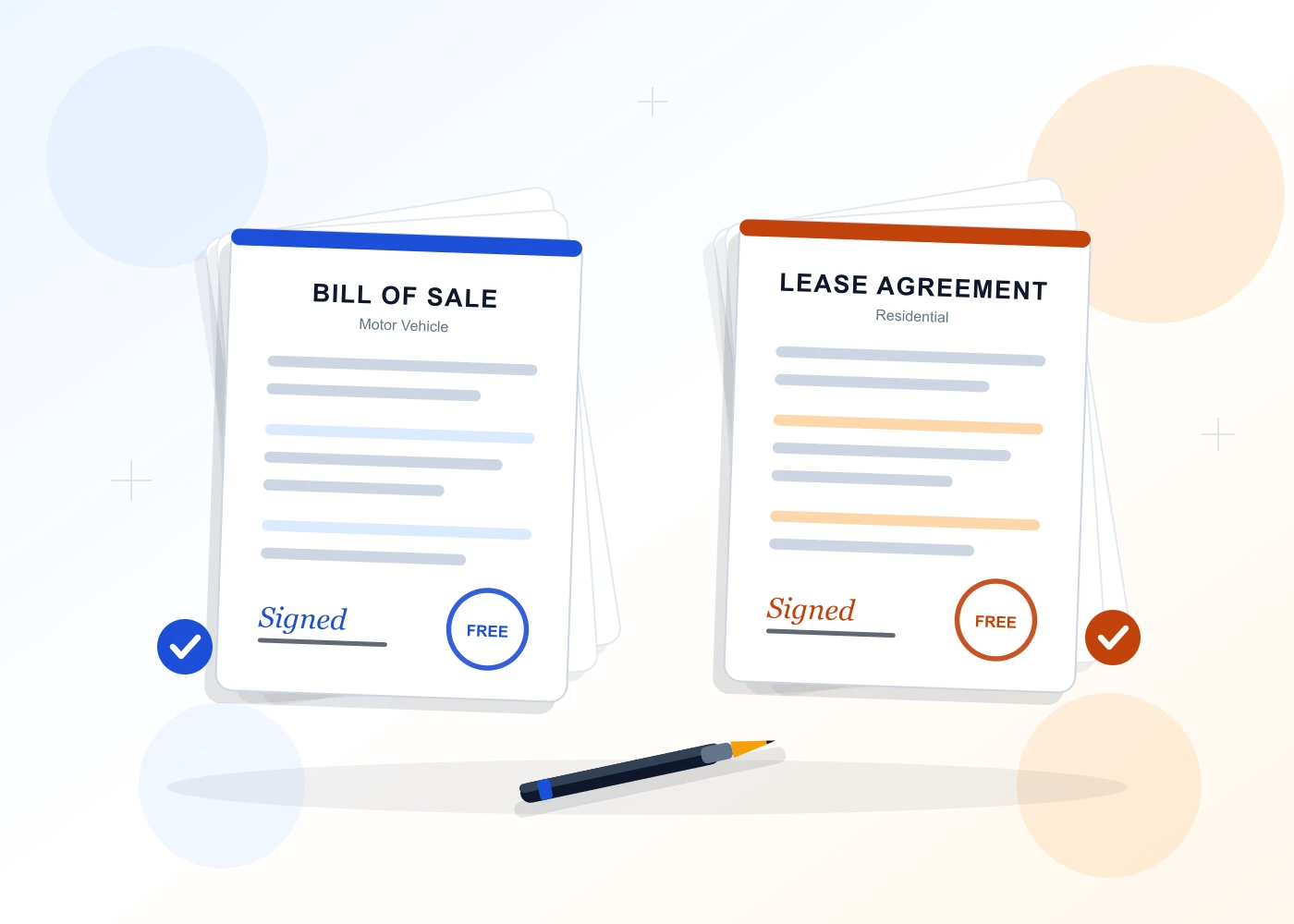
Pick your document
Free bill of sale and lease agreement templates
Motor Vehicle Bill of Sale
Transfer ownership of a car, truck, boat, motorcycle, trailer, or any vehicle - with the odometer disclosure and buyer's acknowledgment included.
- Odometer disclosure included automatically
- Buyer's acknowledgment for the title transfer
- State-specific notary and rule guidance
Residential Lease Agreement
A complete fixed-term or month-to-month rental agreement covering rent, deposits, pets, utilities, and every standard clause.
- Fixed-term or month-to-month
- Deposits, pets, utilities, parking - every clause
- Multiple tenants and co-signers supported
Directory
Browse by state or vehicle type
Every state page includes local quick facts - notarization, disclosure requirements, and filing tips - plus the builder pre-set for that state.
51 state pages per document - each with its own local rules.
Motor Vehicle Bill of Sale by state
Or start without picking a state → AlabamaAL
 AlaskaAK
 ArizonaAZ
 ArkansasAR
 CaliforniaCA
 ColoradoCO
 ConnecticutCT
 DelawareDE
 FloridaFL
 GeorgiaGA
 HawaiiHI
 IdahoID
 IllinoisIL
 IndianaIN
 IowaIA
 KansasKS
 KentuckyKY
 LouisianaLA
 MaineME
 MarylandMD
 MassachusettsMA
 MichiganMI
 MinnesotaMN
 MississippiMS
 MissouriMO
 MontanaMT
 NebraskaNE
 NevadaNV
 New HampshireNH
 New JerseyNJ
 New MexicoNM
 New YorkNY
 North CarolinaNC
 North DakotaND
 OhioOH
 OklahomaOK
 OregonOR
 PennsylvaniaPA
 Rhode IslandRI
 South CarolinaSC
 South DakotaSD
 TennesseeTN
 TexasTX
 UtahUT
 VermontVT
 VirginiaVA
 WashingtonWA
 West VirginiaWV
 WisconsinWI
 WyomingWY
- DCWashington D.C.DC
Residential Lease Agreement by state
Or start without picking a state →- AlabamaAL
- AlaskaAK
- ArizonaAZ
- ArkansasAR
- CaliforniaCA
- ColoradoCO
- ConnecticutCT
- DelawareDE
- FloridaFL
- GeorgiaGA
- HawaiiHI
- IdahoID
- IllinoisIL
- IndianaIN
- IowaIA
- KansasKS
- KentuckyKY
- LouisianaLA
- MaineME
- MarylandMD
- MassachusettsMA
- MichiganMI
- MinnesotaMN
- MississippiMS
- MissouriMO
- MontanaMT
- NebraskaNE
- NevadaNV
- New HampshireNH
- New JerseyNJ
- New MexicoNM
- New YorkNY
- North CarolinaNC
- North DakotaND
- OhioOH
- OklahomaOK
- OregonOR
- PennsylvaniaPA
- Rhode IslandRI
- South CarolinaSC
- South DakotaSD
- TennesseeTN
- TexasTX
- UtahUT
- VermontVT
- VirginiaVA
- WashingtonWA
- West VirginiaWV
- WisconsinWI
- WyomingWY
- DCWashington D.C.DC
How it works
How it works: three steps, about five minutes
- 01
Answer the questions
Pick your state and fill in the guided form. Only what's relevant is asked.
- 02
Review the live preview
Every answer appears on the document instantly, exactly as it will print.
- 03
Download and sign
Get your PDF, print it, and sign with the other party. That's it.
Do I need a bill of sale or a written lease?
A bill of sale isn't required in every state, and not every rental needs a written lease. You want both anyway, because the paper is what proves the deal happened, on what date, and on what terms. One rule worth knowing: in most states a lease running longer than a year has to be in writing to be enforceable, so check your state before you rely on a handshake.
Selling your car privately
Most states don't require a bill of sale to transfer a car, but you want one: it shows what you sold, for how much, and on what date. Sign it the same day you sign the title, and keep your own copy. The mistake sellers make is walking away after handing over the keys. Most states have some version of a release of liability or notice of transfer for the seller to file, and that's the step that keeps the buyer's tickets and tolls off your name. Check whether yours does, and file it the same day.
Buying when there's no title
A bill of sale is not a title, and in most cases it won't get the vehicle registered on its own. Some states have a bonded title route or exempt older vehicles from titling, but that's an application you file, not a shortcut you assume. If the seller can't produce a title in their own name, find out why before money moves: lost, still held by a lender, or never transferred by the previous owner. Get the bill of sale either way, but treat the missing title as the problem to solve first, not something to sort out later.
Gifting a vehicle to family
Still write a bill of sale, and state it as a gift with zero as the amount. People put down $1 to make the form look normal, and that turns a gift into a sale on paper, which can cost the person receiving it at the registration counter. Many states have a family gift exemption with its own form, so check what yours wants before anyone signs.
Selling a boat, ATV, or trailer
Same document, and it carries more weight here because titling for these varies far more than it does for cars. Depending on your state and the type or size, some are titled, some are only registered, and some are neither. Copy the hull number, VIN, or serial number onto the bill of sale exactly as it appears on the item, because that number is what ties the paperwork to the thing you actually sold.
Renting a room in your house
Put it in writing even though it feels stiff with someone who shares your kitchen. The agreement is where you settle rent, guests, which spaces are shared, and what happens to the deposit when they leave. Rules for renting inside a home you live in can work differently from renting out a whole unit, so check how your state treats it rather than assuming standard landlord rules apply.
Tenant already there, nothing written
A handshake month-to-month is a real tenancy in most places, and you can put it in writing now. The mistake is treating the new document as a reset: handing someone a lease doesn't retroactively change what was already agreed, and a rent increase or a move-out still needs whatever notice your state requires. Write down what the arrangement actually is, both sign it, and each keep a copy.
If you are somewhere between two of these, the safer move is to write the document anyway. It costs nothing here and takes about five minutes.
What a bill of sale needs to include
A bill of sale is a short document, which is why people assume it's hard to get wrong. In practice, the ones that cause trouble later are usually missing one specific field, or have the right field filled in sloppily. Here's what belongs on a motor vehicle bill of sale, and what breaks when it isn't there.
Both parties, named in full
Full legal name and current address for the seller and the buyer, spelled the way they appear on their IDs. The clerk processing the transfer compares your bill of sale against the title, so a nickname, a dropped middle initial, or a business name that doesn't match the registered owner can stall it. If the person selling isn't the name printed on the title, find out why before any money moves.
The ID number, copied exactly
Year, make, model and body style describe the vehicle, but the VIN is what legally identifies it, and it's the field people fumble most. Copy it off the title character by character, then check it against the dash plate or the driver's door jamb. VINs issued since 1981 run 17 characters and never contain I, O or Q, so anything that looks like one is really a 1 or a 0. One wrong character sends the whole packet back.
The sale price, written honestly
Put the actual amount paid in numerals, and in words too if the form has room, so no one can add a digit after the fact. Many states calculate sales or use tax from the price on the bill of sale, and some will tax fair market value instead of the number you wrote. For a gift or a trade, record it honestly rather than picking a placeholder number, and give a trade a dollar value because the tax office still needs a figure.
The date the sale actually happened
The sale date is the line between the seller's problem and the buyer's problem: parking tickets, tolls, an accident on the drive home, a car left abandoned somewhere. Many states also start the clock on the seller's release of liability and the buyer's title transfer deadline from that date, so backdating to be helpful can create a late filing out of nothing. Write the real date the keys and money changed hands, and add the time if it's the kind of sale you might need to pin down.
Odometer reading and the federal disclosure
Federal law requires the seller to state the mileage at transfer and the buyer to acknowledge it on most vehicle sales, private ones included. Older vehicles age out of the requirement, but the cutoff depends on the model year and the rule changed a few years back, so don't assume the car in your driveway is exempt. Heavy trucks and non-motorized trailers sit outside it entirely. Record the number exactly as displayed, note whether it reads in miles or kilometres, and mark “not actual mileage” or “exceeds mechanical limits” if either applies, because a made-up number here is odometer fraud.
As-is wording, and its limits
An as-is clause states that the seller makes no promises about condition and gives no warranty, which in most states waives whatever implied warranties a buyer would otherwise have. A few states limit how far that clause can reach, so it isn't a blanket shield. What it never covers is lying: hiding a branded or salvage title, rolling back the odometer, or giving a false answer to a direct question all survive an as-is clause. Include it, and still answer questions straight.
Signatures, and the notary question
Both parties sign and print their names, and both leave with a copy. A bill of sale signed by one side only is close to useless when someone disputes the terms a year later. Whether it needs a notary is entirely a state matter: a few states want a notarized bill of sale before they'll transfer a title, some require it only in narrow situations, and plenty never ask. If a notary is involved, don't sign in advance. Some notarizations require the notary to watch you sign, all of them require your ID, and showing up with a pre-signed form can mean printing it again.
What the document doesn't do
A bill of sale records that the sale happened and on what terms, but for a titled vehicle it's the signed-over title that moves ownership through your state's system, so never release a vehicle on a bill of sale alone. It also doesn't cancel your registration, your plates or your insurance, and it isn't a substitute for whatever notice your state expects the seller to file. Do both: the bill of sale for your record, the state's form for the state.
Cover these and the document stands up where it needs to: the registration counter, the tax office, and any argument that comes later. FormBarn's generator asks for each field in order and includes the odometer disclosure and a notary block, so nothing gets skipped by accident.
What should be in a lease agreement
Arguments between a small landlord and a tenant usually start with something the lease never addressed. A good residential lease is boring and specific: it says who lives there, what they're renting, what they pay, and who fixes what. Here's what to cover before anyone signs.
Every adult who lives there
Name the landlord and every adult tenant with their legal names, then have all of them sign. If the lease says tenants are jointly and severally liable, each one is on the hook for the full rent, so a roommate leaving in month four doesn't cut your rent in half. List children and any non-signing occupants separately, and say what a tenant has to do before someone new moves in.
The property and what's included
Write the full address with the unit number, then list what comes with it: which parking space, which storage locker or garage bay, whether the washer, dryer and fridge stay, whether the tenant gets the yard, basement or attic. Say who pays each utility and whose name each account goes in, including trash, water and sewer, which landlords often keep. If the building shares a water or gas meter, settle how it gets split before the first bill arrives, and check your state first: some require you to disclose a shared meter up front, and some limit what you can bill a tenant for.
Fixed term or month-to-month
A fixed term locks in the rent and the tenancy for a set stretch, and neither side can usually walk away early without consequences, though federal and state law carve out exits for things like active-duty military orders, domestic violence, and a home that isn't habitable. Month-to-month is easier for both sides to end, but the notice each side has to give is set by state law, not by whatever number sounds fair to you. Say what happens when a fixed term expires: it converts to month-to-month, it renews automatically, or it ends and you sign a new one. In many states a tenant who stays on while you keep taking rent becomes month-to-month by default, so write down what you intend rather than leaving it to the default.
Rent, due date and late fees
Put the exact amount, the day it's due, how it gets paid (account, app, mailing address), and what counts as paid on time. If you want a grace period or a late fee, write both into the lease, because a fee that isn't in the document is hard to collect. Late fee limits vary a lot by state: some cap the dollar amount or a percentage of rent, some only require that the fee be reasonable, some are silent. Look up yours before you pick a number.
The security deposit
This is the most state-variable part of any lease. States differ on how much you can collect, whether it has to sit in a separate or interest-bearing account, how many days after move-out you have to return it, and whether you must send an itemized list of deductions. Missing a return deadline can cost you more than the deposit itself in some states, so check your rules, then write the amount and the return process into the lease.
Move-in condition and photos
Do a written condition checklist at move-in, room by room, signed and dated by both of you, and take timestamped photos to go with it. Some states require a checklist or a walkthrough opportunity, but you want one either way. Without it, every deposit deduction turns into your word against theirs about whether that scuff was already on the wall.
Pets, smoking and guests
If pets are allowed, say which animals, how many, and whether you're charging a refundable pet deposit, a one-time fee, or monthly pet rent. Service and assistance animals are handled differently from pets under fair housing rules, so a flat no-pets clause doesn't settle everything, and the pet fees above generally don't apply to an assistance animal either. This is also where smoking, subletting, short-term rentals, and how long a guest can stay before they count as an occupant belong.
Repairs and entry notice
Divide maintenance plainly: who changes furnace filters and smoke detector batteries, who handles lawn and snow, who pays when a tenant clogs the drain. Give tenants one specific way to report problems in writing so there's a record of when you were told. Then write your entry rules, because most states require advance notice before a landlord enters except in an emergency, and the notice period is set by state law.
Required disclosures
Federal law requires a lead-based paint disclosure, the EPA pamphlet, and a warning statement in the lease for most housing built before 1978. States and cities add their own on top: mold, bed bug history, flood risk, who manages the property, and other items that vary widely. Missing disclosures carry real penalties, so check your state and city list before you hand the lease over.
A specific lease is tedious to write once and easy to enforce for years. FormBarn's lease generator walks these sections in order, free, with no signup, no watermark, and nothing you type gets stored.
Why people use it
Why people use FormBarn
Done in minutes
Answer plain-English questions and watch the document write itself in the live preview.
Drafts auto-save
Close the tab and come back later - your progress is saved on your device.
Clean, printable PDF
A professionally formatted document ready to print, sign, and file.
Private by design
No account, no email address. Every answer stays in your browser and the finished PDF is never written to our servers.
Questions
Frequently asked questions
Is FormBarn really free?
Yes. Creating, previewing, and downloading your Bill of Sale or Lease Agreement is completely free - no signup, no watermark, and no charge at the download step.
Are the documents legally valid?
FormBarn documents follow the standard structure accepted across the US, and each state page lists that state's specific rules, such as notarization requirements. For unusual situations, have a local attorney review your document.
Do I need to create an account?
No. There are no accounts. Your draft is saved automatically in your own browser, and we never see or store the information you enter.
Does a bill of sale transfer ownership, or do I still need the title?
The bill of sale records the deal: who sold what, to whom, for how much, on what date. The title is what actually transfers legal ownership, and it has to be signed over and processed through your state's motor vehicle agency. Some states also want a bill of sale at registration; plenty never ask for one, though you should still keep your copy. Check what your state asks for before you head to the counter.
Does the Bill of Sale include the odometer disclosure?
Yes. For motor vehicles, FormBarn generates the federal odometer disclosure statement and a buyer's acknowledgment alongside the bill of sale itself.
Can I use this if the car still has a loan on it, or I lost the title?
You can generate the bill of sale either way, but it won't solve the title problem. When there's a lien, the lender typically holds the title or has to release it before ownership can move, so the payoff usually needs to happen at or before the sale. If the title is lost, request a duplicate from your state's motor vehicle agency first.
Do the buyer and seller each need a signed copy?
Yes, and the easiest time to handle it is right there at the signing. Print two copies, have both parties sign both, and each side keeps one. Same goes for a lease: every adult tenant on the agreement signs, and the landlord and each tenant should walk away with a fully signed copy.
Can I make a month-to-month lease?
Yes. The lease builder supports both fixed-term and month-to-month agreements, including notice periods, prorated rent, deposits, pets, utilities, and parking clauses.
How much can I charge for a security deposit?
That number is set by your state, not by the form. Caps, return deadlines and itemized-deduction rules all vary, so look up your state before you fill in the amount.
Does my document need to be notarized?
It depends on your state and the document. Some states require a notarized bill of sale to transfer a vehicle title, while most residential leases need no notary at all. Every state page on FormBarn lists that state's notary rule, and the generated document includes a notary block when one is expected.
What if I spot a mistake after I download the PDF?
Just make a new one. Your answers stay in your browser, so you can go back, fix the field, and download a fresh copy at no cost. If the document is already signed, don't scratch out and initial over the error; print a corrected version and have both parties sign and date that one instead.
Can I fill this out on my phone?
Yes. The form, the live preview, and the PDF download all work in a mobile browser, and there's nothing to install. Just plan for a printer, since both sides still need something to sign.
Still unsure? Send us a question - a person reads every one.
Ready when you are.
Both documents are free, take about five minutes, and nothing you type leaves your browser.